
David Nassief
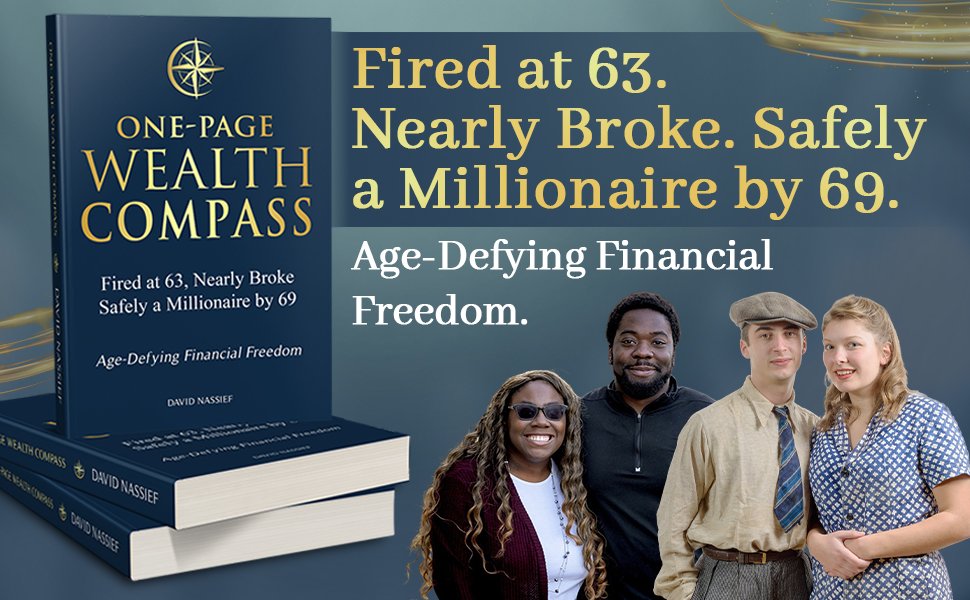
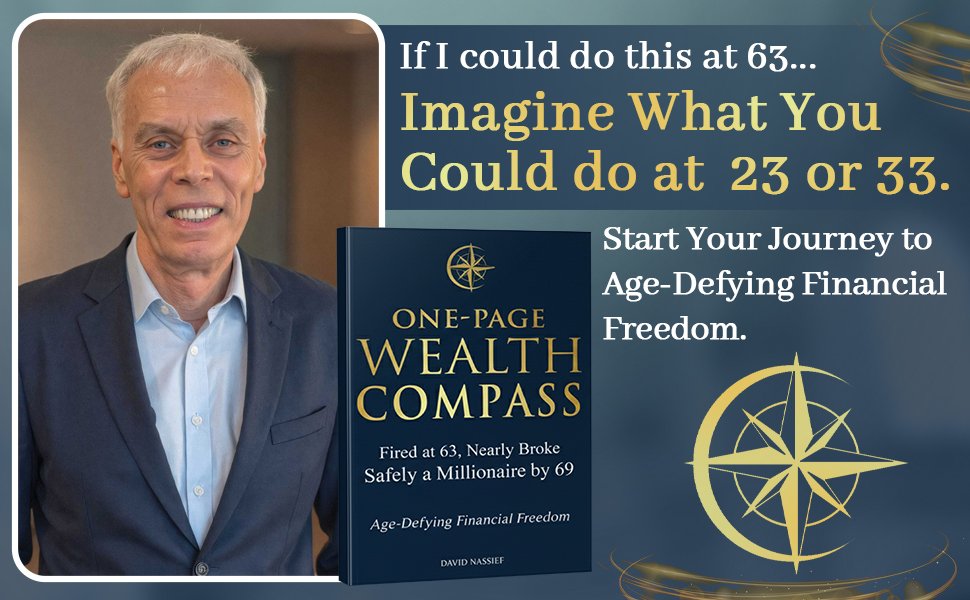
Fired at 63 Nearly Broke, Safely a Millionaire by 69
I spent most of my career in the corporate world before the system deemed me “unemployable.” Using a simple, one-page wealth compass, I navigated my way to financial freedom in under six years. Now, I’m sharing that exact compass to help others feeling that quiet desperation find their way with a simple set it and forget it approach.
Get the Wealth Compass That Got Me
Financial Freedom in Under Six Years
This one-page PDF did for me in under six years what I failed to do in forty.
I went from nearly broke at 63 to a millionaire by 69 using this exact one-page.
Download it now to get the simplified, automated strategies.
Learn my Two-Minute Direction Check for weekly progress.
The ultimate ‘Set it and Forget it’ system for radical financial simplicity.
Get updates and offers ➜
- Includes the 'Set it and Forget it' automated wealth strategy.
#1 Amazon Hot New Release First Week Out in Persoal Money Management
The one page compass guides people from confusion to clarity and helps them navigate the most direct path to their goal

Hitting Rock Bottom at 63
Why Getting Fired and Nearly Going Broke Changed Everything
The elevator doors closed behind me for the last time on a late Tuesday afternoon. Eighteen years reduced to a cardboard box. “Effective immediately.”
Two words that shattered everything I thought I knew about security, loyalty, and my place in the world. I’d heard those words in movies and read them in news articles about other people’s lives. I never imagined they’d be spoken to me in the familiar conference room where I’d celebrated important team wins and participated in countless meetings for nearly two decades.
The senior manager’s voice seemed distant and muffled as he continued with the standard script—turning in my office keys, my company computer, and my company car. But all I could think of was, “Is this really happening?” Eighteen years of early mornings, late nights, missed family dinners, and weekend emails. Gone.
THE COMPASS

The Wealth Compass — One Page. One Direction.
A single page I still use today to guide every major financial decision.
The Wealth Compass is the page you want when clarity matters most.
Instead of more rules, spreadsheets, or strategies, it helps you see where you are, what truly matters, and how to decide what comes next.
It isn’t a system.
It isn’t a course.
It isn’t a checklist.
It’s one page — when simplicity is what you really need.
What’s on the One-Page Wealth Compass
- 9 financial “trail markers” that show where you really stand
- 5 guiding principles behind every money decision
- A way to spot misalignment early
- A framework that works at any age or stage
Free when you join my newsletter
Age-Defying Financial Freedom
How I Rebuilt My Future at 63 (And How You Can, Too)
“They whispered I was finished when I got fired at 63—just two years from being broke. But I wasn’t done yet.”
I thought I’d done everything right. But when I was fired after 18 years, the math hit hard: even if I drained all my savings and retirement, I’d be broke by 65.
So, out of necessity, I built a simple One-Page Wealth Compass — and it worked.
Inside the Book You'll Discover:
- How a janitor with only a high school diploma and a modest paycheck retired with over $8 million, while one in four doctors, many earning 10X as much, end up with only six figures.
- The 7-Step Wealth Accelerator that turned a tiny nest egg into seven figures, achieving in under six years what most take 30 years or more.
- The average NBA player earns $10 million a year, yet 60% go broke within five years of retirement. Meanwhile, a basketball-loving carpenter quietly became a multimillionaire on an average income. How does this happen?
- Ordinary employees can build more wealth than many business owners—without the stress, risk, or 80-hour weeks
- The Smart Protection Fund – how a simple twist on the old emergency fund can safely 10X your financial reserves.
- Set-It-and-Forget-It Wealth: Why doing nothing beat every strategy I tried for 40 years
Getting fired at 63 was the worst day of my life — until it became the best. Six years later, I had the freedom I’d fought 40 years to find. The compass that got me there is now yours.
Watch Official Book Trailer
Commission earned from this link helps support this site at no extra cost to you.
NOT DONE YET
Hard-Won Insights on Wealth and Financial Defiance
They said I was finished at 63. I was just getting started. Dig into the stories and strategies that turned my worst-case scenario into a seven-figure future.

June 24th, 2026
In 2008, a young man graduated from law school second to the last in his class. The Great Recession was raging, legal jobs openings were slim even for top graduates, and his prospects looked incredibly grim.
But he had a hidden superpower: he had chosen a state university, worked multiple jobs in the summer and part-time during school, and graduated completely debt-free with a small cushion of savings.
Because he had no monthly payments breathing down his neck, he took a risk and opened his own practice. For thirteen months, he made next to nothing, sometimes taking cases for free just to get experience. Then, the tide turned. Business picked up so fast that he needed to hire help.
He ended up hiring the valedictorian from his exact same graduating class. That top student was brilliant, but he was drowning in student loan debt and desperately needed a regular paycheck just to stay afloat.
The real trap of debt isn’t just the interest rate. It’s how it suffocates your options and limits your potential. When you don’t have your own plan, you simply become part of someone else’s.
A Tale of Two Mortgages
The choices you make with debt can turn a sudden setback into a total disaster. Take two homeowners who face the exact same scenario: a sudden job layoff during a major recession.
The first homeowner followed the standard lender’s advice and took out a thirty-year mortgage. By year twelve, the recession hits, their investments crash, they fall behind on payments, and foreclosure looms. They aren’t just looking for a job, they are forced to hunt for a job with ten times the stress because they are fighting to keep a roof over their family’s head.
The second homeowner ignored the lender’s guidelines. They opted for a fifteen-year mortgage and paid extra toward the principal whenever they could. By year eleven, they own the house free and clear. When the layoff hits in year twelve, there is no panic. They can look for their next career move with peace and focus because their housing is secure.
The moral is: Never let a lender’s guidelines become your buying guidelines.
The Fiduciary
Wall Street loves to pitch a strategy called debt arbitrage. Financial advisors routinely tell clients to borrow money rather than paying cash, claiming you’ll build more wealth by keeping your money in the market.
A retiree named Jason got this advice from his financial advisor. He had the cash ready to pay for a $100,000 garage addition to store his car collection. His advisor intervened, arguing that his market returns were beating the cost of a loan, so Jason financed the project instead.
Shortly after, the market crashed. Jason’s portfolio plummeted, forcing him to severely cut back his retirement lifestyle. To make matters worse, he was stuck with an unnecessary monthly loan payment that cramped his budget even further.
Ironically, the advisor’s website prominently advertised a “fiduciary” commitment right on the homepage. But when advisors give advice that protects their asset-management fees at the expense of your financial safety, that is a serious conflict of interest. True freedom comes from avoiding unnecessary debt and using a reliable compass to chart your own correct course.
In 2008, a young man graduated from law school second to the last in his class. The Great Recession was raging, legal...
June 19th, 2026
Wall Street loves to paint a picture-perfect retirement. Their slick brochures show couples walking on pristine beaches, playing endless rounds of golf, and enjoying a life of pure, uninterrupted leisure. They tell you that if you just hand over your money for them to manage, they will hand you back this dream lifestyle.
But there is a dangerous reality they leave completely out of the brochure.
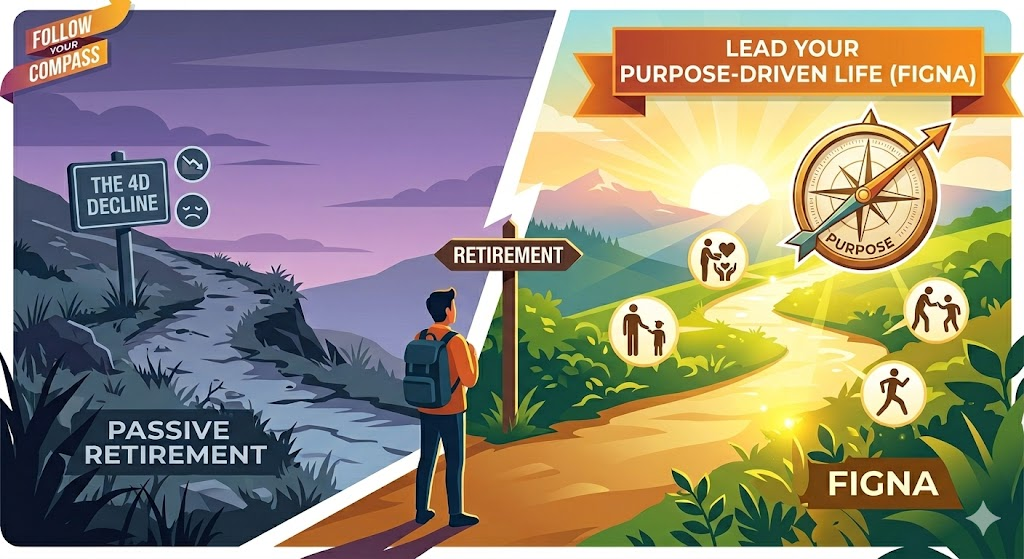
When you walk away from your career, you aren’t just leaving a job. You are leaving your daily purpose and the structured goals you built over 40 years. Without a clear mission to replace it, many people slide into a rapid, multi-level shutdown — something I call the 4D Decline.
Face the Facts: The 4D Decline
Your body and mind are designed to contribute, not just consume. When you eliminate your mission, the consequences are stark and scientifically proven:
- Dementia (Cognitive Decline): Data from Harvard Medical School reveals that dropping complex, daily mental challenges cuts your brain’s cognitive resilience literally in half. It is the ultimate rule of the mind: use it or lose it.
- Depression: A massive study spanning 11 European countries found that entering full retirement triggers a staggering 40% increase in the risk of depression.
- Disability: Data from the University of Michigan’s landmark Health and Retirement Study shows that walking away from active, structured goals triggers an immediate 16% spike in physical mobility limitations.
- Death: Research published in the British Medical Journal tracking thousands of employees showed that retiring at age 55 instead of 65 literally doubles mortality risk. Eliminating your mission is quite literally life-threatening.
The Emptiness of the Permanent Vacation
Sociologist Robert Atchley’s landmark research shows that new retirees quickly slide into a predictable psychological trap:
- The Honeymoon Phase: A brief period of excitement and relaxation.
- Disenchantment: The novelty wears off, and a lack of direction sets in.
- The Emptiness Realization: People quickly discover that endless leisure without a sense of contribution feels a lot less like freedom and a lot more like a void.
The primary health challenge in later life is replacing the natural structure that a career provides. Simply having free time is never enough. A landmark Harvard study of professionals revealed that having fun doesn’t protect your health. Feeling useful does. Seniors who actively volunteer have a 30% decrease in mortality compared to those focusing solely on self-indulgence and hobbies.
Living with Ikigai: Create a Life Without a Finish Line
If you look at the “Blue Zones”, the regions of the world where people routinely live past 100 with sharp minds and active bodies, you will find something fascinating: they have absolutely no word for retirement.
Instead, in places like Okinawa, Japan, they live by the word Ikigai, which translates to “the reason you get out of bed in the morning.” For a 102-year-old karate master, it’s teaching. For a 100-year-old fisherman, it’s feeding his village.
Leisure and fun are great, but they are the dessert of life. They are not the appetizer, the salad, and the entree.
Time to FIGNA: Graduate to Your Next Adventure
It is time to ditch the outdated Wall Street concept of checking out and sliding into shutdown. It’s time for FIGNA: Financial Independence, Graduate to Next Adventure.
Achieving financial freedom shouldn’t mean crossing a finish line into emptiness. It means gaining the total freedom to choose your next mission. Whether that means volunteering regularly at a local food bank, coaching youth sports, or teaching literacy, you don’t want to just show up when you feel like it. You need a structured focus to give your days real purpose.
Wall Street may sell you a portfolio, but they can’t sell you a purpose. To navigate this transition safely, you need a simple, clear, one-page compass to guide you into your next chapter.
Stop buying into the pitch of a multi-level shutdown. Take control of your financial independence, keep your mind sharp, and give yourself a real reason to wake up with excitement every single day. Follow your compass on a fulfilling journey at any age.
Wall Street loves to paint a picture-perfect retirement. Their slick brochures show couples walking on pristine beaches, playing endless rounds of golf,...

June 4th, 2026
Every year, Wall Street spends billions of dollars on a very specific marketing message.
It is designed to make you feel overwhelmed, uncertain, and entirely dependent on traditional financial planners.
They tell you it’s too complicated. They warn you it’s too dangerous to handle on your own.
Then, they hand you a 50-page document packed with dense charts, winding graphs, and rows of tables. When you look at it and think, “Wow, this is incredibly complex, I’m glad I have an expert handling this,” they have won.
That 50-page report isn’t designed to inform you; it is designed to create a sense of fear and dependency.
The Real Cost of “Expertise”
When traditional financial advisors discuss their fees, they rarely frame them in actual dollar amounts. Instead, they talk in small percentages. It sounds harmless, but when those seemingly minor percentages compound over decades, they can easily eat up 20% to 30% of your total retirement nest egg.
Paying a third of your life savings in fees is a heavy price to pay just to avoid complexity. But to understand why people willingly pay it, you have to look at what happens when emotion takes over the steering wheel.
A Tale of Two Investors
A close friend of mine is a highly competent financial advisor, and during a week when the stock market took a massive downturn, we ran into each other at Home Depot. While I view a down market as a great buying opportunity, most people see it as a crisis.
He told me about a client of his, a highly intelligent architect, who had been frantically calling his office all day long. When my friend finally got him on the phone, the man was practically hyperventilating.
“I’m losing my shirt!” the architect panicked. “I’m losing everything, my entire retirement! We have to get out. I need to get into cash right now!”
My friend listened calmly, let him vent, and then gently reminded him of their actual plan. He explained how they had already allocated a segment of the portfolio into fixed assets specifically to weather these exact storms, meaning his immediate income wasn’t being touched by the market drop. He told him the absolute worst thing you can do when the market is down is sell, because doing so locks in your losses and makes them permanent.
Once the architect calmed down, he realized the plan was solid and stayed the course.
The Cost of Panic
That architect is exactly the kind of person who needs a traditional financial advisor. Why? Because without that steady voice calming him down, his emotional panic would have driven him to liquidate his portfolio at the worst time.
While giving up 20% to 30% of your wealth to advisory fees hurts, it is still a better outcome than riding an emotional roller coaster and destroying 50% to 70% of your portfolio through panic-selling and trying to time the market.
Why Simplicity Wins
There is a fundamental truth to building sustainable wealth:
Simplicity is for winners. Complexity is for victims.
You don’t need a 50-page document to manage your financial future safely, nor do you need to be held hostage by emotional panic. A truly successful strategy can actually be boiled down to a single page.
When I was fired at age 63, I found myself nearly broke and facing an uncertain future. I didn’t turn to a complex corporate institution. Instead, I dedicated myself to learning, reading 21 personal finance books, and listening to 13 different podcasts consistently. Every time I found a solid, reliable principle, I wrote it down.
Eventually, I distilled all of that knowledge into a single-page blueprint: the One-Page Wealth Compass.
By focusing on a simple, reliable path rather than a complicated web of investments, I achieved what once felt impossible: transitioning from nearly broke at 63 to a safe, seven-figure portfolio by age 69.
You Are the CEO of Your Wealth
The decision to manage your own investments or work with a traditional advisor is entirely yours. Competent professionals provide immense value when they act as a behavioral guardrail, keeping panicked investors from making costly emotional moves.
However, whether you use an advisor or manage your own portfolio, you must remember one non-negotiable rule: You must be the CEO of your own wealth building.
You cannot delegate the key decisions to anyone else. It requires taking the time to understand the core mechanics of the market, staying grounded during volatility, and keeping your strategy clean and straightforward.
If you want to look at the exact single-page framework I used to rebuild my financial life, you can grab a copy of the OnePageWealthCompass.com/free entirely for free.
At the end of the day, remember this simple truth: Nobody cares more about your wealth than you do. Nobody!
Every year, Wall Street spends billions of dollars on a very specific marketing message. It is designed to make you feel overwhelmed,...

May 28th, 2026
“Making money is different from building wealth.”
I’ve been thinking about this distinction a lot lately. Making money is about your current income, but building wealth is about creating lasting security, peace of mind, and the freedom to design your life on your own terms. It is about moving away from constant complexity and creating an automated foundation that supports your true purpose.
Wherever you are on your path to financial freedom, I wanted to take a moment to check in.
I would love to hear your story. Go to the contact form on this site to share your thoughts with me, and let me know:
-
What is working well for you right now? What wins have you had lately?
-
What challenges or roadblocks are you running into? What is causing the most friction?
I read every single message that comes through. I care deeply about your progress, and hearing where you are right now helps ensure I am sharing the absolute best insights to help you build a reliable compass for your financial future.
Let me know what’s happening in your world.
“Making money is different from building wealth.” I’ve been thinking about this distinction a lot lately. Making money is about your current...
May 10th, 2026
If a financial strategy can take someone from “nearly broke” at 63 to a millionaire by 69, imagine what it can do for you with more time on your side.
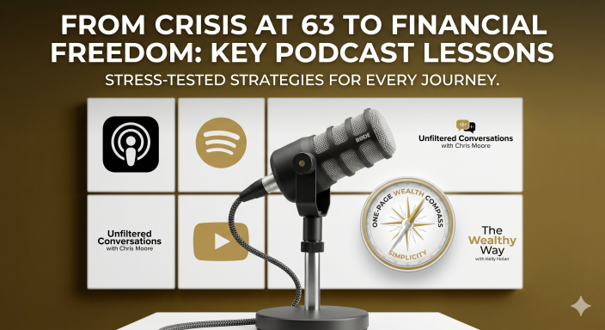
I’ve been spending a lot of time on the podcast circuit lately talking about the “stress test.” I lived through the worst-case scenario, and the only reason I’m on the other side of it is because of a shift in how I viewed wealth, hidden fees, and simplicity.
I wanted to share these conversations with you because the lessons I learned in the trenches apply whether you are 25 or 75.
Here is what a few of the hosts had to say about the “One-Page” approach:
How to Listen or Watch
If you’d like to explore these episodes, you can find them easily:
- On Podcasts: Search for David Nassief on Apple Podcasts or Spotify.
- On YouTube: Search David Nassief if you prefer to watch the full video interviews and see the strategies in action.
Whether you’re looking to protect what you’ve built or you are navigating a “watershed moment” of your own, these episodes are designed to provide a clear path forward.
One of the key things I discuss in these interviews is how to keep your financial plan automated so you can focus on living your life rather than managing your spreadsheets.
See you on the airwaves,
If a financial strategy can take someone from “nearly broke” at 63 to a millionaire by 69, imagine what it can do...
April 29th, 2026
Life has a way of throwing curveballs when we least expect them. We’ve all been in that spot where the math doesn’t seem to add up and the “experts” make everything sound far more complicated than it needs to be.
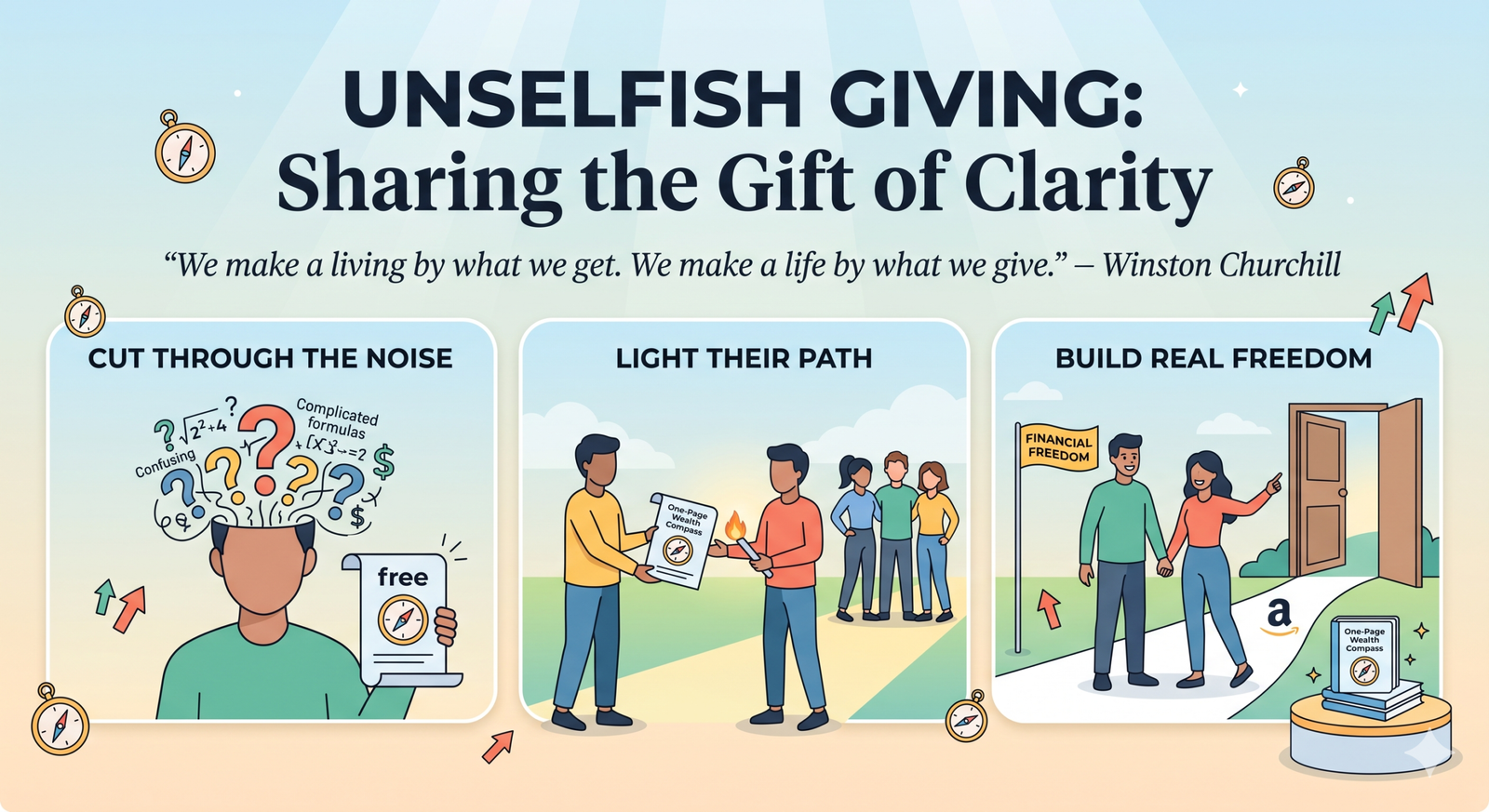
If you’ve found value in the One-Page Wealth Compass, there’s likely someone in your circle—a friend, a sibling, or a colleague—who is currently feeling that same weight.
You can help them cut through the noise and confusion.
One of the most effective ways to find peace is to adopt a “Set it and Forget it” approach to building real financial freedom. It’s about moving away from the chaos and toward a radically simple system that actually works without requiring any financial background.
If you know someone who could use a straightforward guide to reaching their own version of financial freedom, why not gift them a way to get on a path to real freedom?
Scan or Click the QR Code below to find the book on Amazon:

“We make a living by what we get. We make a life by what we give.” — Winston Churchill
Sometimes, one simple resource is all it takes to change the trajectory of a person’s life.
Life has a way of throwing curveballs when we least expect them. We’ve all been in that spot where the math doesn’t...
April 28th, 2026
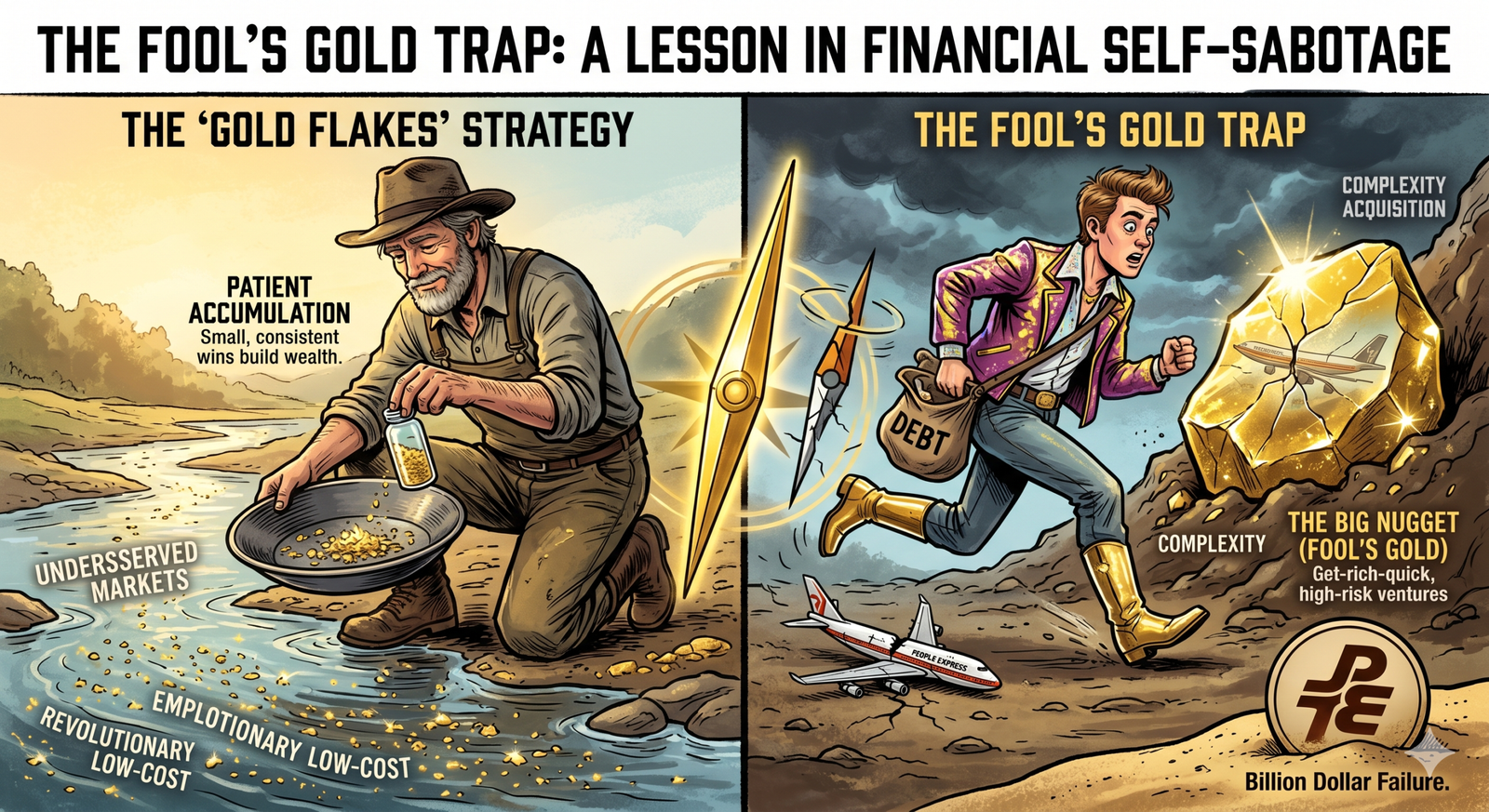
The story of People Express Airlines is a stunning, high-altitude lesson in financial self-sabotage that everyone should know about. In the 1980s, the airline was the fastest growing success story in aviation history, yet it collapsed in just six years. The reason wasn’t a market crash or a bad economy; it was the leadership’s conscious decision to abandon what worked for something that merely looked shinier.
This mistake, which tanked a billion dollar company, is the same one that may be sabotaging your wealth right now. It is the insidious pull of the Fool’s Gold Trap.
The “Gold Flakes” Strategy That Built an Empire
In the world of wealth building, there are two types of people: those who spend their lives hunting for a single, massive gold nugget, and those who retire wealthy by patiently collecting “gold flakes.”
People Express’s initial success was a masterpiece of strategic simplicity. They didn’t try to win the “nugget” of the entire aviation industry at once. Instead, they focused on a smart and patient “gold flakes” growth formula:
- Revolutionary Low-Cost Model: Passengers paid only for what they wanted. This made their prices competitive with a bus ticket.
- Employee Ownership: Everyone from pilots to ticket agents was a shareholder, resulting in unparalleled productivity and enthusiastic service.
- Underserved Markets: They patiently built routes in smaller cities that major airlines ignored, accumulating small, reliable earnings.
Their success wasn’t built on massive, risky ventures. It was built on the less flashy accumulation of countless tiny, profitable wins. Like the old-timer in the California Gold Rush, they became rich by collecting the tiny, shining gold flakes that the younger, impatient prospectors overlooked while they searched for a mythical jackpot.
The Decision That Destroyed Everything
The collapse began the moment the brilliant minds at People Express fell for the Fool’s Gold Trap. They grew restless with their “slow and steady” accumulation and decided they wanted the big, shiny nuggets of the major competitive markets.
They leased a 747 for a Newark to London route and started making strategic departures that eroded their core advantage:
- Complexity: They added a first class section, violating their all economy, no frills model.
- Overhead: They started offering free checked bags and complimentary drinks to compete with the giants, obliterating their foundational low cost advantage.
- The Final Gamble: They doubled down on disaster by acquiring the bleeding, culturally incompatible Frontier Airlines.
Their structure dissolved under massive debt. By the time they realized they had lost their way, they had no compass to guide them back. The company was sold for a bargain and ceased to exist.
Where You Might Be Chasing Fool’s Gold
This isn’t just an airline story; it’s a universal warning for your personal finances. You chase fool’s gold when you:
- Abandon the Reliable: You ditch a profitable side hustle (the gold flake) for a get rich quick scheme (the shiny nugget).
- Erode the Margin: You swap a consistently profitable, “Set it and Forget it” investment strategy for an unproven, high risk venture because the former “isn’t sexy enough.”
- Lifestyle Creep: You add “must have” debt like a luxury car or a second home after a raise, instead of investing a smart portion of the difference.
People Express was so successful that their success became their downfall. They believed they were bigger than the basics. If you want to avoid their fate, stop looking for the one big win that will change your life and start focusing on the gold flakes that build lasting freedom.
The story of People Express Airlines is a stunning, high-altitude lesson in financial self-sabotage that everyone should know about. In the 1980s,...
April 28th, 2026
The $4,500 October Nightmare: How to Stop the Financial Scramble
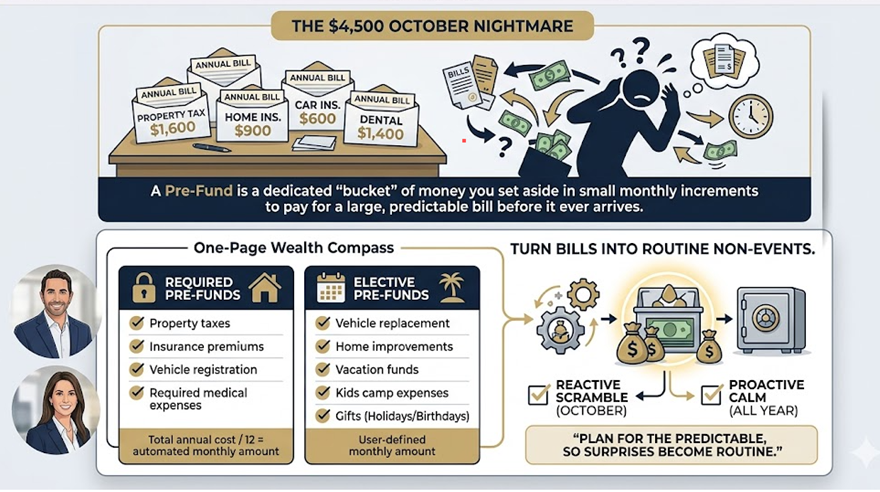
Picture this: You’re sitting at your kitchen table, surrounded by bills that all decided to show up at the same party uninvited. Property tax: $1,600. Home insurance: $900. Car insurance: $600. And just for fun, a $1,400 dental bill your wife mentioned months ago but you “conveniently” forgot about.
This was exactly my reality a few years ago.
On paper, I was doing great. My agency was profitable, my investments were growing, and I thought I had good control of all my money. Yet, there I was, scrambling like I was living paycheck to paycheck, moving money between accounts like pieces on a chess board. It was annoying, disorganized, and completely preventable.
That night, I realized I was wasting hours of mental energy on a problem I could have solved with ten minutes of planning. That’s when I turned to a system that changed everything.
Your Personal Financial Time Machine
To fix this, I used a simple tool I call a Pre-Fund.
A Pre-Fund is a dedicated “bucket” of money you set aside in small monthly increments to pay for a large, predictable bill before it ever arrives.
Think of it as a financial time machine. Your past self sends money forward to your future self, making you your own hero. Instead of being blindsided by a $1,200 annual bill, you simply see it as a $100-per-month “subscription” to your future peace of mind.
Ancient Wisdom for Modern Stress
This isn’t just modern accounting; it’s ancient wisdom. Four thousand years ago, Joseph saved Egypt from famine by storing grain during the years of abundance. He didn’t wait for the famine to hit; he prepared while the fields were full.
Most people treat their bank accounts like a waiting room for bills. A Pre-Fund turns it into a storage room. By using a “Set it and Forget it” approach, you stop reacting to your life and start leading it.
The Two Pillars of Peace
In the One-Page Wealth Compass system, we break these down into two simple categories:
- Required Pre-Funds: These are the “Must-Haves.” Taxes, insurance, and medical costs. You calculate the annual cost, divide by 12, and automate the savings. When the bill arrives, the money is already there. You just write the check and move on.
- Elective Pre-Funds: These are your “Dreams on Autopilot.” This is how you fund vacations or buy a car with cash. Because you’ve planned ahead, you can enjoy these things without a “debt hangover.”
From Scramble to Satisfaction
The following year, when those same October bills arrived, something magical happened. Instead of stress, I felt satisfaction. The bills were no longer “surprises”, they were “non-events.”
You go from a victim mindset (“Why do these all hit at once?”) to a victorious mindset (“I saw this coming and I’m ready”).
Your 2-Minute Direction Check
You don’t need a complex spreadsheet to start.
- List: Find one predictable bill over $100 that hits you once or twice a year.
- Divide: Take that total and divide it by 12.
- Automate: Set up a recurring transfer to a separate account today.
When you plan for the predictable, you clear the mental space to focus on what actually matters. Stop the scramble and start your time machine today.
The $4,500 October Nightmare: How to Stop the Financial Scramble Picture this: You’re sitting at your kitchen table, surrounded by bills that...

April 23rd, 2026
Most people spend their lives staring at a “retirement” date on a calendar, treating it like a finish line where they finally get to stop. I realized that the finish line is actually a new starting block.
At 69, I reached FIGNA: Financial Independence, Graduate to Next Adventure.
For me, “Graduating” didn’t mean sitting on a porch. It meant having the total autonomy to choose how I spend my greatest asset: Time.
Because my wealth is locked into an automated, Set it and Forget it trajectory, the “money stress” that used to keep me up at night has been replaced by a new kind of energy. I’m no longer trading hours for dollars; I’m trading ideas for impact.
Today, my “Next Adventure” is built on my terms. It’s the freedom to build a B2B legacy business with my son, Adam, and the peace of mind that comes from knowing my foundation is strong. The One-Page Wealth Compass didn’t just save my bank account; it saved my future. It turned a corporate exit into a professional rebirth.
Financial Independence isn’t about hitting a magic number and quitting. It’s about reaching the point where your system provides the fuel, so you can finally decide where the car is going. I graduated to a life where I love working in my agency with my son. It is an honor to be able to share my compass with others to help them reach FIGNA—giving them the freedom to do whatever they want, whenever they want. I also look forward to the volunteer work I do each month with charities I believe in.
The flywheel is spinning. The strategy is set. Now, the only question is: Once you stop worrying about the climb, where will your next adventure take you?
Most people spend their lives staring at a “retirement” date on a calendar, treating it like a finish line where they finally...
April 23rd, 2026
The Tipping Point: When the Flywheel Takes Over
In those first few years after I was fired, it was 100% hustle. My sales agency was the only thing moving the needle. I was the one making the calls, closing the deals, and fueling the tank. If I stopped moving, the progress stopped. It was exhausting, but I wasn’t just working for a paycheck—I was building the momentum required to start the spin.
Then, the tipping point arrived.
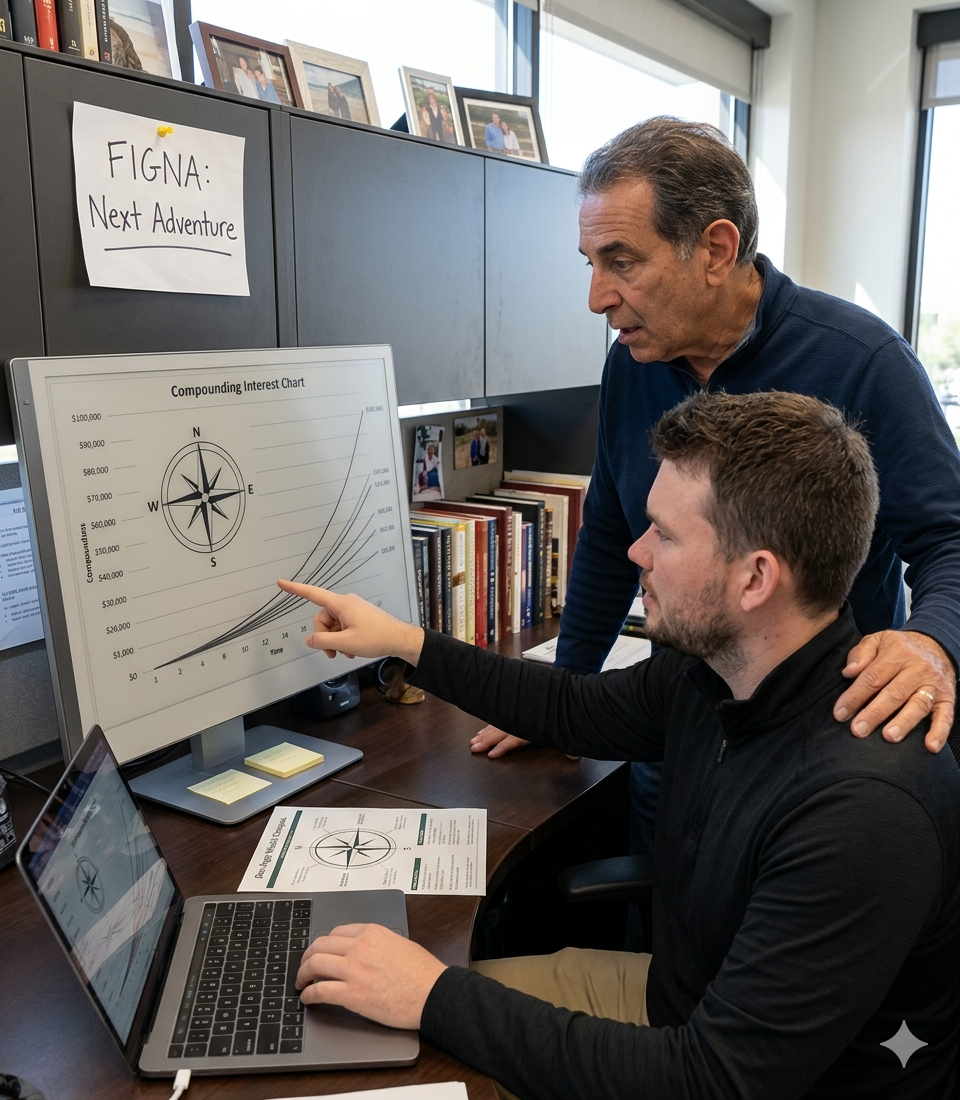
I remember looking at my One-Page Wealth Compass and realizing that for the first time, my investments had grown more in a single month than I had earned through my own labor.
The roles had reversed.
I was no longer the one pushing the weight; the momentum was finally pulling me. This wasn’t because I found a “magic” stock or a lucky break. It was because I was following a trajectory that didn’t allow for “shiny object” detours. I stayed in my lane, and the compounding finally caught up.
By the time I officially crossed the millionaire line, the “flywheel effect” was in full force. My money had finally graduated from being a passive passenger to being a high-performance engine powering my wealth building.
The goal isn’t just to make more money. The goal is to reach that tipping point where your lifestyle is powered by your system, not your sweat.
I started at 63 with a two-year runway. By 69, the flywheel was doing the work I used to do. It’s never too late to start the spin.
The Tipping Point: When the Flywheel Takes Over In those first few years after I was fired, it was 100% hustle. My...
I'd Love To Hear From You
Whether you’re looking for a fresh financial voice for an interview, an engaging speaker for your event, or simply have a question, I’d love to hear from you. Use this form to reach out anytime.
Remember: Your worst day can become the first day of your best chapter—you just can’t see it yet.